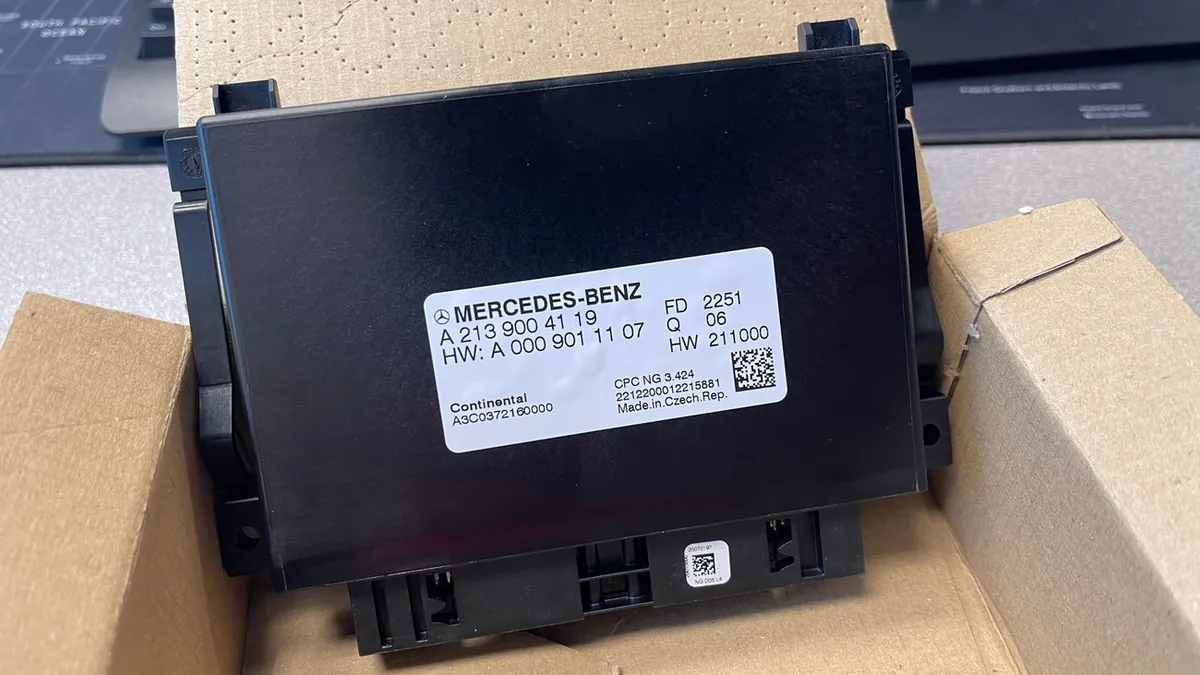
If you've tuned a modern Mercedes-Benz and felt like the results didn't match expectations, the CPC may be exactly why.
What the CPC Is
The CPC, Central Powertrain Controller, is a dedicated control module that Mercedes-Benz introduced in its later model lineup to manage powertrain functions that previously lived inside the ECU. Depending on the platform, the CPC oversees overall torque output, the active exhaust valves, throttle pedal response, intercooler water pump operation, radiator fan control, and the vehicle's speed limiter. On vehicles equipped with the 9G-Tronic nine-speed transmission, it also plays a role in coordinating the added complexity that transmission introduced into the powertrain control architecture.
The CPC is present across a broad range of modern Mercedes-Benz vehicles, AMG performance models and standard production cars alike, and on any vehicle manufactured from approximately 2020 onward, it has become a primary gatekeeper of how the powertrain actually performs.
Why It Matters for a Tuned Mercedes
Here is where things get important for anyone who has modified, or is planning to modify, a modern Mercedes: the CPC contains its own set of torque limiters that operate independently from the ECU. Even when the ECU has been calibrated to produce more power, the CPC can and will intervene, pulling ignition timing and reducing boost to bring output back within its own limits. On many 2020 and newer Mercedes vehicles, an ECU tune alone produces little to no meaningful power gain for exactly this reason. The CPC simply overrides it.
This makes the CPC not just a complementary upgrade to an ECU calibration, but a required one on modern platforms. Tuning the ECU without addressing the CPC on these vehicles is like widening a road while leaving a toll booth at the end of it.
What CPC Tuning Unlocks
A properly calibrated CPC works in coordination with the ECU rather than against it, allowing the engine to operate at the output the ECU is actually calibrated for. Beyond removing the torque ceiling, CPC calibration also addresses the speed limiter, intercooler pump flow rates, ensuring the cooling circuit operates at full capacity under high load, exhaust valve behavior, and throttle response characteristics. The result isn't just more peak power; it's a powertrain that behaves consistently and cohesively rather than one where two control systems are working at cross purposes.
ECU, TCU, and CPC: A Complete Torque Model
Here's where many otherwise well-intentioned builds still fall short: addressing the ECU and CPC without also calibrating the TCU. The transmission control unit carries its own torque model, a set of values that defines how much torque the transmission expects the engine to be producing at any given moment, and how it shifts and manages clutch pressure accordingly. When the ECU is calibrated for more power but the TCU's torque model hasn't been updated to match, the transmission is effectively operating blind to the actual output of the engine. The result is shift behavior that doesn't reflect the new power level, clutch engagement that isn't optimized for the added torque, and a powertrain that still isn't performing as a unified system.
This is where the CPC's role becomes most significant. On modern Mercedes platforms, the CPC sits at the center of the powertrain control architecture, it doesn't just limit the ECU, it communicates with both the ECU and the TCU, passing torque information between them and acting as the arbitrator for how power is requested, delivered, and managed across the entire drivetrain. Getting the CPC right is what allows the ECU and TCU to share a common, accurate torque model rather than each operating on different assumptions about what the engine is doing.
A complete calibration on a modern Mercedes isn't three separate tunes applied to three separate modules, it's one cohesive torque model implemented across all three, with the CPC tying it together. Anything less leaves the system working against itself in ways that may not be immediately obvious but will show up in how the car actually drives.
If you're driving a modern Mercedes-Benz and want to understand what a complete ECU, CPC, and TCU calibration looks like for your platform, our team can walk you through exactly what's involved and where your specific vehicle stands.